It was with both anticipation and trepidation that I began reading Havisham, a novel which undertakes to tell the story of Miss Havisham in a new way, while also promising that she will ‘exceed all expectations’ (sigh). As someone who has spent many years of my life devoted to the study and enjoyment of Dickens, while I was excited to see what the author had done with such a well-known story, I was also somewhat sceptical. Miss Havisham’s story is so well known, so entrenched in our understanding of Victorian gothic culture, that it takes a certain amount of nerve to attempt to cast her story in a new light. The real question therefore becomes did this re-telling work?
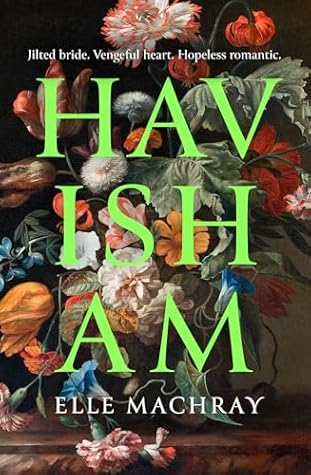
It is very clear from the outset the author knows Great Expectations well, and she had done a lot of research both on the novel itself, and the nineteenth-century historical and social context in which the novel was set, but the main difficulty that the author struggled to overcome is one simply of the magnitude of the task. The reality is that when you take on Miss Havisham as a central character imbued with her own driving narrative force, and you strip her of all her symbolic power, which this incarnation of the story does by taking her out of her wedding dress, the end result is that you make her something lesser. I can only equate what Machray did with Miss Havisham as being equivalent to taking Frankenstein’s monstrous creation and making him into a Disneyesque Pinocchio.
Miss Havisham, as Catherine Waters notes in Dickens and the Politics of Family, forms the focus for a cluster of ideas associated with sterility, solitude, decay and death in the novel. As such, she has immense symbolic power, brimming with fury and rage. Machray does pick up on this, referring to Miss Havisham’s wedding dress at the beginning of the novel, as being a ‘silk coffin’ into which Miss Havisham has fastened herself (p. 3), with Miss Havisham the ‘living corpse in a rotten wedding dress’ (p. 5). But there are times when the Satis House of Great Expectations is unrecognisable, such as the ‘fresh-cut lavender tulips’ which seem almost jarring in the setting, given the entropic decline of both Miss Havisham and Satis House following the aborted wedding.
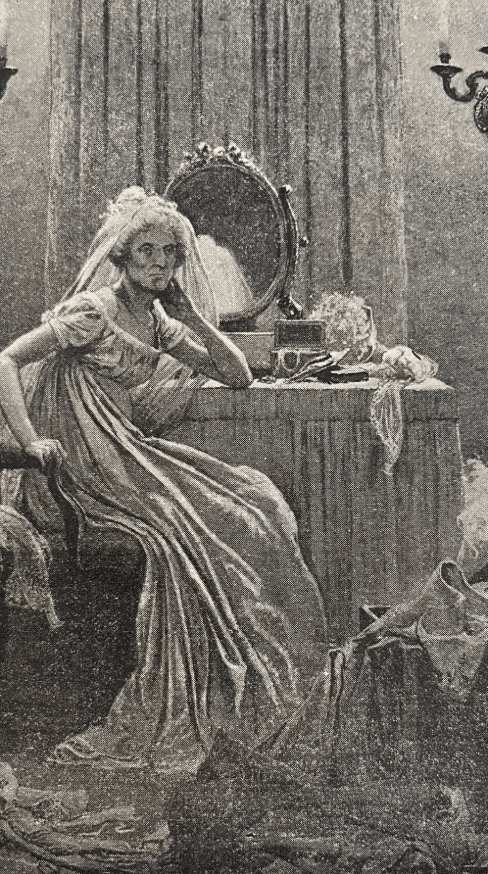
Miss Havisham is given a name by Machray, Charlotte, a Dickensian name in the sense that it had been used in Bleak House with Esther’s maid Charley. But with her name came character traits those familiar with Great Expectations are unlikely to recognise. In keeping with the current publishing obsession with diversity, she was queered, forming an attraction to Molly, and is also given a racialised heritage. Her mother is described as being a ‘madwoman, a mulatto no less’ (p. 8). The end result is that with this new rendition of Miss Havisham, we have a racialised and queer woman, who was having her sanity questioned. This sat very uncomfortably for this reader.
On a general point, Dickensians can be outraged when fundamental aspects of a character are portrayed in a way which defies expectations, but when changes are made simply for the sake of it (as for example, the last BBC production of Great Expectations where Mrs Joe was seen wielding a whip on Mr Pumblechook) it undermines the purpose of a re-telling – especially when that re-telling of the story purports to give the character a voice. The difficulty here is that Miss Havisham had a voice – and it was a powerful one. People in Dickens’s world had a perception of her that may not have been positive, but they recognised her as a woman who deserved some respect or reverence, even as she was made a spectacle over. This portrayal, this new iteration of her diminished her. Jaggers too became something he was never supposed to be, with an attraction formed to Arthur, and his aloofness as a lawyer (along with Dickens’s scathing indictment of the legal system) was therefore lost.
As a reader, Machray’s research sometimes bogged down the narrative. I can understand wanting to show off your research, but I felt the whole of the novel could have done with a tighter edit, as quite often, there was information given within the narrative that the reader simply didn’t need and didn’t add anything to the reader’s understanding of what was going on. It made the book harder to read, and at times, dull.
The ending was somewhat infuriating, especially if you love the ending of the original novel, as I do. It was also problematic, and very difficult for someone who loves Great Expectations to be comfortable with. We all know how Dickens agonised over the ending, and given what was going on in his personal life at the time, when he was still dealing with the aftermath of the scandal of his separation from his wife, while conducting an affair with a woman younger than his daughter, Machray’s revised ending really grated.
In Great Expectations Dickens was doing a lot of things with Miss Havisham, with a narrative arc that is still studied and discussed with interest and awe. Giving Charlotte her happy ending and thereby disrupting the narrative arcs of characters such as Estella and Pip changes the way in which Great Expectations works as a narrative whole.
Dickensians are not going to love this adaptation. In fact, the difficulty with this book is that there are already enough books out there which re-imagine the characters from this novel, picking up from what Dickens did with them, and working with these characters in a way that both honours the source material while looking at the characters in a new way. Think Estella’s Revenge by Barbara Havelock or Havisham by Ronald Frame. Miss Havisham, as an iconic character, had a story. In giving her a happy ending, even if it is one with another woman, her story becomes forgettable.
Dickens’s legacy endured and Great Expectations is remembered because Dickens was a novelistic genius. This novel, in many ways, proves the point made by Anthony Trollope in his 1857 novel Barchester Towers, that when a novelist attempts to rival Dickens, they commit no fault, though they may be foolish. It was an interesting read. But for me, this was not a novel that does justice to the original, or adds anything in terms of an interpretative new approach to Miss Havisham as a character.
 Deborah Siddoway