Here we go again: putting a finished novel out on submission, hoping against all hope that somehow, it manages to find the right home.
The novel in question has been a work of passion for me, written as I finished off my PhD, the story somehow never managing to leave me, even as the pressures of life, and the very real demands of my doctoral research and thesis pressed on me.
Having finished the novel, and edited it down to something I am really proud of, it is really important to me that I can find a publisher who gets what I have done, for this is not a book that has been written in a conventional way, and it is very different to my last published work.
In short I have written a feminist version of Charles Dickens’s Hard Times, told from the point of view of three of his female characters. I could tell you all the things I would write in a submission letter to literary agents, but I think the publication journey for this book is one that is not necessarily going to include an agent. I don’t want to go into my reasons for this, but I think his book needs a publisher with an ethos that aligns with the thematic issues my book explores. Accordingly, I have identified a number of suitable independent publishers to submit to directly, and am slowly going through that process.
Which is where things started to get interesting. One of these publishers requested not a synopsis and extract, but asked that I provide them with a review – OF MY OWN NOVEL. The thought of writing a review of my own work is one that proved somewhat daunting, and it took me a little while to settle to the task, not being entirely sure how to approach it – whether as a book review, or from an academic standpoint, or some amalgamation of both. In the end, I just wrote, as I often write, what I wanted. It ended up being quite an interesting writing exercise for me on its own, and one I think I will adopt for everything I write, going forward.
For those who are interested, here it is, together with a mock-up of a book cover, which I did just for fun, because sometimes it is important for you to visualise the book that you will one day hold in your hands. Writers, it would be really interesting to know what you think of the idea of reviewing your own work – I would be grateful for any comments.
A Review of No Voice but Hers, A Novel by Deborah Siddoway
In No Voice but Hers Deborah Siddoway presents the reader with a raw and searing re-telling of Hard Times, as three of the women from Charles Dickens’s 1854 novel each regain their own unique voice, seizing control of the narrative. Like Hard Times, No Voice but Hers is divided into three books, with each book told from the point of view of one female character: the alcoholic wife of Stephen Blackpool, the MP’s daughter Louisa Bounderby, and factory worker Rachael. In doing so, the industrial hellscape of Coketown is seen through a uniquely feminist lens, challenging the patriarchal orthodoxy which saw women as lesser. The mirroring of Dickens is also apparent in Siddoway’s use of the same chapter titles as those which Dickens created when the book was first published as a complete novel, a thematic connection to each chapter cleverly weaved into Siddoway’s version of what is arguably the bleakest of all of Dickens’s novels.
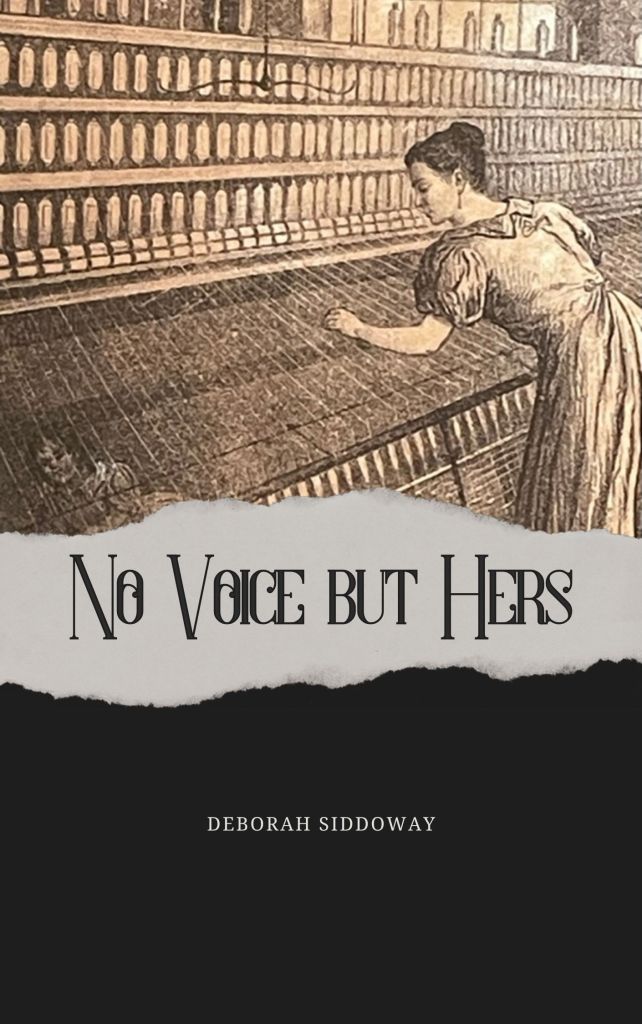
The title of Siddoway’s novel comes from chapter XI of the first book of Hard Times, where Stephen Blackpool awaits Rachael, a woman who is not his wife, as ‘no voice but hers could effect’ the ‘softening of his anger’. It is a more than appropriate title for a novel in which women’s voices are prioritised. Throughout the entirety of No Voice but Hers a desperate yearning to be heard is discernible as each of the women is given a platform to have her voice amplified. In giving these women a voice Siddoway also attempts to address some of the earliest criticism levied against Dickens. It was the English novelist George Gissing, author of over twenty books, including New Grub Street of 1891, who said that ‘the working class is not Dickens’s field’ while at the same time saying that ‘Dickens did not know the north of England.’[1] In No Voice But Hers, Siddoway demonstrates her familiarity with both, as she confronts the brutal reality of life in the industrial north, through the voices of the women. These women are made real as they share their dreams, their pain, their silenced anger, and their frustration at the confines of life for a woman living ‘in a world in which women were made for men, and not for each other’, as Rachael laments.
Indeed, Dickens is frequently criticised for his poor portrayal of his female characters, who are often little more than one-dimensional renderings of what a woman was expected to be within the respectable middle-class nineteenth-century society in which Dickens lived. For Dickens, to be a daughter, a sister, or a wife, was to offer selfless devotion to the male on the other side of that equation – the father, brother, or husband. And while Dickens was unafraid to create female characters who did not love their husbands (Edith Dombey, for example, from Dombey and Son) or women who had left their husbands (such as Betsey Trotwood from David Copperfield), he often failed to explore in depth the reasons underlying the antipathy in the marital relationship. Even when he did, often, the finger of blame was pointed towards the woman. With her novel Siddoway flips the Dickensian script, telling her story, not his.
The book opens with the narrative of the wife of Stephen Blackpool. Not even given a name in Dickens’s novel, Stephen Blackpool’s wife was cast as a device for Dickens to argue for the freedom to divorce at a time when divorce was not readily available in England. His working notes specifically reference his intention to ‘Open Law of Divorce’. His creation of Mrs Blackpool also coincided with Dickens’s own experience of marital unhappiness. As he wrote Hard Times, Dickens was beginning to contemplate abandoning his own wife, and as a character who was effectively little more than a scientific specimen to prove the need for divorce to be more accessible, Mrs Blackpool was depicted as nothing better than an alcoholic scourge on the life of her miserable and pitiable husband. Seen only as a failed wife, in this re-working of the Dickensian tale, Siddoway gives this wife a name, and with her name, a story, told with an almost uncomfortable honesty, as she shares her past, scarred as it is by parental loss and a childhood lost to factory labour and abuse. In doing so, Siddoway gives Kit back her own story and agency as a woman in a world in which people of the working class, especially young working class girls, were expendable. As Kit says, women like her were ‘chewed up and spat out, a broken carcass of the woman you used to be. Used up, ruined, useless.’ It is a story that still resonates today, given the current grooming gangs scandal continuing to unfold.
When Siddoway was asked about her approach to the telling of Kit’s story, and why she had chosen to adopt such a close first person narrative style, she simply said, ‘I wanted the reader to be able to imagine her, standing against a bar, getting more and more drunk as the evening went on, exchanging her story for drinks. Indeed, in my mind, Kit could have been sharing her story with Dickens himself.’
In Book the Second the narrative style shifts, becoming more distant, as Louisa Bounderby’s story is told. While Louisa’s character is explored in more depth than any other female character in Hard Times, Siddoway shifts the focus on to the more coercive aspects of Louisa’s marriage. On writing Louisa, Siddoway said: ‘it was only in writing her story I saw the significance of Bounderby acquiring his country retreat after his marriage to Louisa. This enabled him to put a distance between Louisa and her childhood home, isolating her from the family and the life she had known. It is a tactic often employed by an emotionally manipulative and abusive man, and it was important to me that this featured as part of her story, for I know how important it is for women to have help when they are trying to extricate themselves from the poisoned tentacles of such relationships.’
Finally, Book the Third allows Rachael to have her opportunity to give her perspective on her love for a married man. Siddoway confirms she found Rachael the most difficult of the characters to write. ‘Rachael was tricky,’ Siddoway said. ‘She was one of those characters who kept everything closed off, even to me. Don’t trust her,’ Siddoway advised. ‘Never trust her.’
Siddoway is more than aware that there are many aspects of her novel which will no doubt upset or infuriate the Dickens purists, not least of which is the development of the Sapphic aspects of the relationship between Louisa and Sissy Jupe, as well as the suggestion that the factory owner Bounderby has paedophilic proclivities. Yet Siddoway is unapologetic. ‘When Dickens wrote his novel,’ she said, ‘he wanted it to make a difference. I want to do the same. The issues Dickens was dealing with in the mid-nineteenth century are in many ways no different to those confronting people today – a cost of living crisis, workers struggling to make a living, and exploitation of the working class by those in positions of wealth and power. Like Dickens, I wanted to shine a light on these issues.’
No Voice But Hers is without question an ambitious novel, challenging conventional narrative styles, as Siddoway interrogates the past, disrupting the accepted literary understanding of Dickens’s novel and the characters he created, as she unlocks the caged voices of the women of Coketown. ‘When Dickens was writing,’ Siddoway said, ‘he would describe a story as grabbing him by the throat. That’s how the writing of this novel felt. It grabbed me by the throat and wouldn’t let me go until I had finished it.’
No Voice but Hers, published by [ ] is Deborah Siddoway’s second novel. Deborah Siddoway is a solicitor and novelist who completed a PhD at Durham University, exploring divorce and divorce law reform in the nineteenth-century English novel. She was awarded an MA by research in Dickens Studies from the University of Buckingham, won the 2019 Partlow Prize for a paper since published in the Dickens Quarterly, and has also been published in The Dickensian. She is a contributor to Celebrating Women in Legal History: Making and Shaping a Discipline, published by Hart Publishing in 2026, and is a familiar face on the Dickensian circuit, regularly speaking at Dickens Day and the international Dickens Society annual Symposium. Her first novel, Dark Waters, was published by Bloodhound Books.
[1] George Gissing, Charles Dickens: A Critical Study (Blackie and Son, 1898), pp. 201-02.
 Deborah Siddoway