In many ways, it is more than a little bit cheeky to call this a Christmas story, when what I am really doing is extracting out two chapters of my unpublished novel, both of which happen to be set during Christmas.
What is interesting for me as a writer, is that both of these chapters represent two out of the three times in the book that the point of view is shifted from the main character, Emma, to that of her husband Ford. These snippets you are getting are the first two times we see the world through his eyes. The final time his point of view is prioritised in the novel was largely out of necessity – as it occurs after the death of Emma. But before then, and for nearly the entirety of the novel, we see her world through her.
I decided to do this, to allow the reader to experience Ford’s point of view, because I wanted the reader to see a different version of Emma – the Emma who existed under the direct glare of the male gaze, the Emma who had a role to play for her husband, the Emma whose purpose as model and muse for her artist husband meant he often lost sight of the woman she truly was. And she lost herself somewhere along the way.
Emma’s story was not a happy one, although she had some happy moments in her life. Uneducated, working class, struggling to find her place in a world she never felt truly comfortable in, all while seeking the one thing she never felt she truly had – the love of her husband. But those moments, moments where she becomes more than a face to be painted, those were the moments I wanted to capture as I told her story.
Christmas 1867 was one of those moments. Nineteen years after she first met Ford, he sketches her once again. The two portraits could not be more different. The first time, she was compliant. This second time, she is defiant.
I hope you enjoy, and have a wonderful holiday season with your family.
Aux deux Crayons – Christmas 1867
Christmas was approaching. The older Ford got, the more difficult Christmas became, reminding him of all he had lost. Though he engaged in a constant battle to avoid dwelling on the past, his blackness sometimes conquered him, forcing him to confront his ghosts. Even now, when she had been dead for more than two decades, it was very hard not to miss Elisabeth, not to imagine how very different his life might have been if she had but lived. And then, of course, he could not help but lament the loss of his two buried sons, the babies who had lived such pitiably short lives.
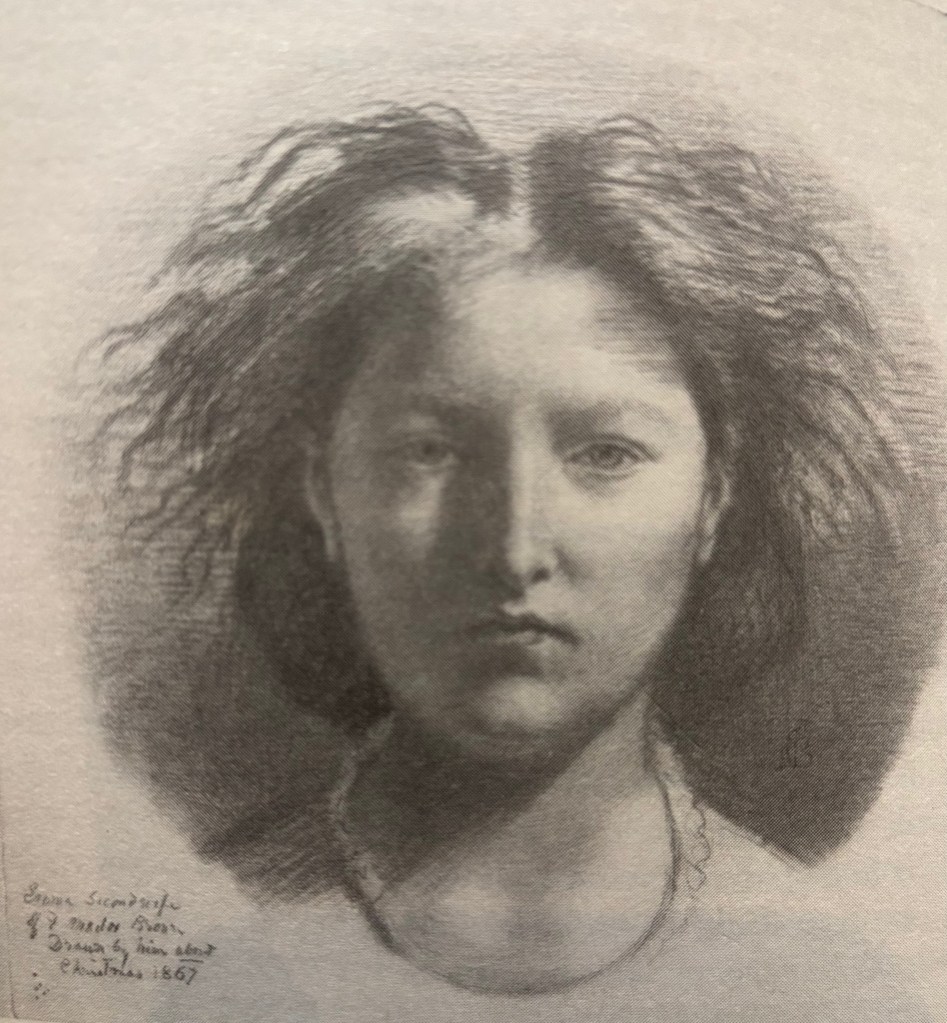
As ever, Christmas was a time for reflection, and as the coldness of winter closed in, a time for drawing. Bundled up with a blanket over his knees, he took up his pencil, his thoughts taking flight as he strove to capture the truth on paper one pencil stroke at a time. But the truth was not always to his liking.
He was sketching Emma again. His wife. He remembered the first time he had drawn her; it must have been Christmas nearly twenty years previously. She had been so shy, and so very young. She had barely looked at him, her gaze demurely down, her beautiful fair hair neatly and decorously pinned up to expose her neck, elongated and sensual in her pose, utterly oblivious to the power of her innocent beauty, entirely unaware of just how alluring she was.
Now, she looked directly at him. There was no love in her eyes, only confrontation, as if she could see right through him. Her hair, no longer a golden halo, having darkened with maturity, was in wild disarray despite the snood she was wearing in an attempt to maintain an orderly style. That first time, she had been a joy to sketch, her pose exquisite despite the imperfections which made her beauty unique. He had captured her as she had parted her lips, a soft sigh setting flight. But now, nothing could escape from her set jaw and tense mouth. There was no joy or happiness in her expression. Nor was there demureness. She simply stared at him, and the only thing he felt himself capturing on the paper was the contempt she clearly felt for him. Her scorn radiated from her eyes.
He did not deserve her hostility. He had done nothing wrong.
While he knew that she resented his student, Marie, the exceptionally talented painter who had been coming to him for tuition for the past two or three years, it was hardly his fault that Marie was also an exotic beauty, one of the ‘Three Graces’ to take fashionable London by storm, leaving a trail of besotted artists in their wake. He had only taken her on because Gabriel had asked him to.
But dear God, she was the epitome of artistic beauty. Marie. One look. That was all it had taken. He was smitten. And when he spoke with her his enchantment was complete. Her intelligence was as attractive to him as her sultry beauty. He was totally and irrevocably in love. He had felt a violent yearning stirring inside of him, a tempest after years of sedate calm. All reason fled from him. Marie had only to ask. He would do anything for her.
And Emma knew. Of course she knew. Which is why she glared at him so piercingly as he sketched her now.
 Deborah Siddoway