I have just received a letter in the mail from Northumberland County Council that an application in relation to the construction and operation of a renewable energy scheme on land at Whittonstall is going to be heard. I plan on attending, as I did with the first meeting considering the application. I wanted to share my experience of what happened during that first meeting, and why I think it is of vital importance that every resident makes their voices heard. The planning committee will not be acting in your best interests if they approve this scheme. After all, they pretty much conceded this during the last time this was before the council. Let me explain.

On 15 April 2025, I attended a meeting at Northumberland County Council relating to the proposal to construct what will be a solar farm near the beautiful, quiet little village of Whittonstall. I had been aware of the application for some time and have submitted two objections related to the proposal, along with the many other objections lodged by members of the local community.
I had been aware there had been significant environmental and infrastructure issues in relation to the proposal that would need to be overcome before the proposal could be approved. So, imagine my surprise when a letter from Northumberland County Council landed on my door mat, indicating that the application was due to be decided. It seemed impossible that the developer could have overcome all the many issues that would point to the need for the application to be denied. I was beginning to suspect that someone had an agenda to push, an agenda completely at odds with any benefits for anyone in the local community.
I had never been to a meeting of a local council planning committee before. Yet having received the letter, just days before the meeting was due to take place, I knew that I needed to go. What I saw at the meeting made me question, in a way I never had before, how the needs of a local community can be made subordinate to all other considerations. For when I left the meeting, I heard the disbelief of those locals who were in the gallery, and the whispered comments:
‘Someone has very deep pockets, and someone must have their hand in them.’
Given what I witnessed at that meeting, I am unsurprised that anyone could come to that conclusion. For I was thinking that exact same thing.
From the outset, I want to state that I am making no accusations. Perhaps I misunderstood something about how the process works. After all, I have never been to such a meeting before and know little about how it works. And while I have some legal knowledge, I know next to nothing about planning laws and how they are applied.
Let me tell you what I saw.
The meeting opened with a presentation relating to the proposal. I think, for the first time, I began to appreciate just how extensive the proposal was: 91,392 panels placed on what is currently green agricultural land. Let’s put that into perspective. This is not a small development – it is huge. According to Eon energy, they recently fitted a development with 7,700 solar panels, which is the equivalent of eight football pitches. I am not good at maths – but the Whittonstall proposal would equate to a minimum of 45-50 football pitches worth of solar panels foisted on us, becoming an industrial complex that would be seen for miles.
The presentation went on to assert that no heritage aspects were directly affected, but that there were public rights of way through the proposed area.
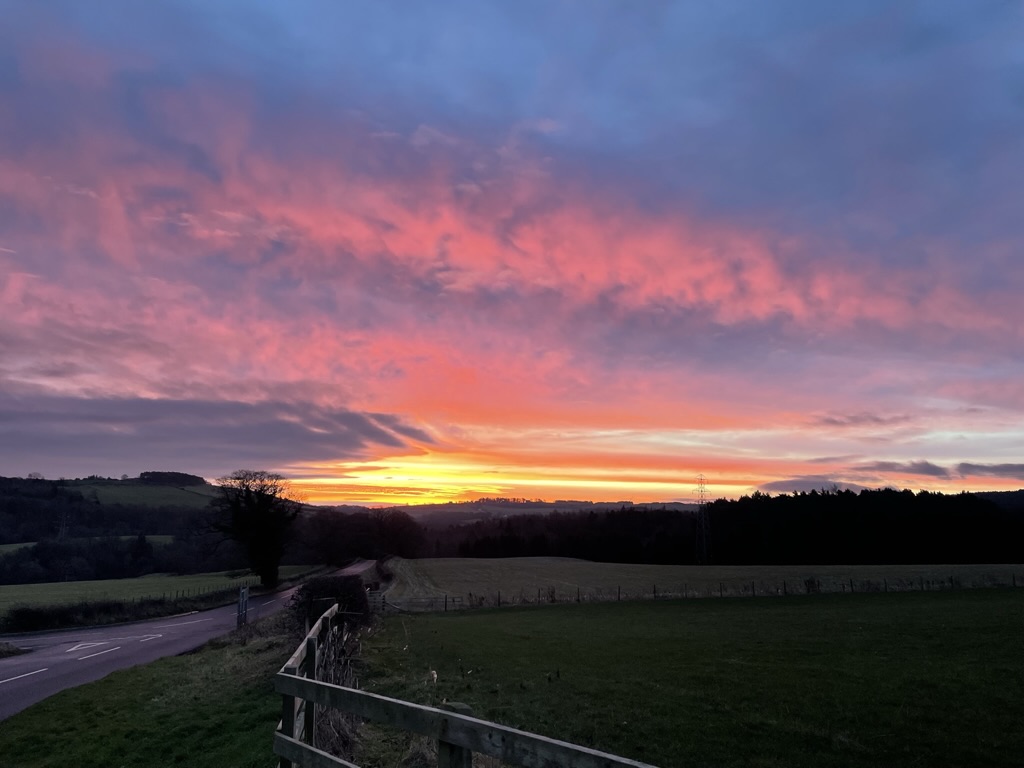
The presentation we were shown had been carefully crafted, with lots of photos showing the area that would be impacted by the proposal. The planning officer asserted he had taken the photos in different seasons, yet in every photo, the sky was bright blue. For those who live in the local area, we know that a blue sky is more of an anomaly than a regular feature. A quick glance at the weather forecast will show you that often our skies are covered in cloud. But I guess when you want to get a solar farm approved, you have to give the impression that we live in a lovely, sunny area, entirely suitable for the purposes of harnessing solar power. The photos were all also rather generic: a ploughed field, a rickety fence. What the photos didn’t show was how elevated the site is, how exposed, and how beautiful the landscape is. The photos could have been anywhere, and it was clear they were nothing more than a heavily filtered sales pitch to sell something the local community neither needs nor wants.
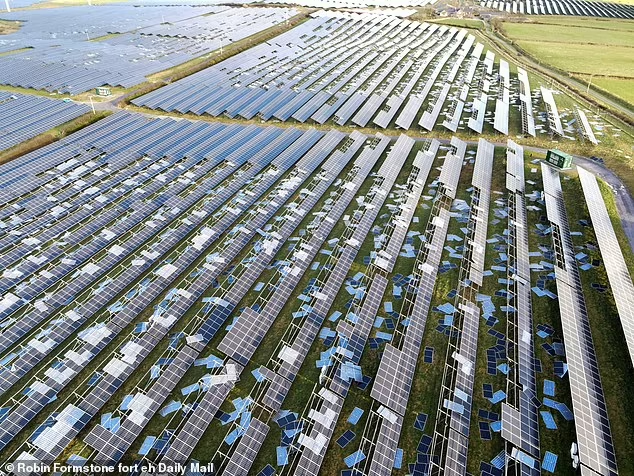
The officer then went on to outline some of the potential problems. They recognised that there would need to be some ‘shielding’ and talked of the developer planting trees to achieve this, as if trees would be able to blot out the industrialised monstrosity they plan on covering the land with. In doing so, they pointed out that some of the existing woodland has been storm damaged, so there were benefits in planting new trees. At no point, however, did they point out the obvious flaw – that if the trees on the site are susceptible to storm damage, then any solar panels positioned there would be similarly vulnerable. For those of us who live here, and know the vagaries of the weather, storms are a fact of life. We often have to deal with tree damage. I wonder what damage could be done to solar panels on an elevated location, and how much damage that would do to the environment? We know that extensive solar panel damage was done during the recent Arwen and Darragh storms.
The planning officer then went on to talk about how the developer planned to ameliorate the detrimental impact of the development on the local wildlife and ecology, with the incorporation of skylark plots (I have to confess to not understanding how a skylark is supposed to know where it should be making its home). They also suggested working with local hive keepers to establish beehives under or around the solar panels to encourage biodiversity. When I later mentioned this to a local beekeeper, they laughed. It was, as ever, a preposterous suggestion.
The planning officer then, importantly, also conceded that they did not have a finalised method for submerging a cable, a necessary part of the requisite infrastructure, but it was acknowledged that it would have go through green belt land, and that it would need to go over Lynn Burn bridge. I don’t know anything about the logisitics of this, but it is yet another example of the patent unsuitability of the site for a scheme such as the one proposed.
Then came the kicker. The planning committee decided that the land for where the battery storage facility would need to go was considered by them to be ‘grey belt’. At this point in time, it is important to note that ‘grey belt’ is not a formal planning term but is used to denote what is actually green belt land, but land that is ‘underused’ and is therefore considered potentially suitable for development. No one has actually classified the land as being ‘grey belt’, however, it was put forward as being ‘grey belt’ as a justification for approving the development. Call me sceptical, but what a useful little term ‘grey belt’ is to deploy here, yet another sales tactic for something we don’t want
There was also some muttering as to how the land used to be a mining site that it was also suitable for situating a mass of solar panels. I was seething at this point. This land is a part of our soul, our history, and our heritage, and while it may have once been used for mining, it is now a peaceful, beautiful landscape enjoyed by all in the local community. Just because the earth was once rent open is not justification for despoiling the land once more. If someone is assaulted, it doesn’t mean it is acceptable to assault them a second time, just because the scars are now faded and no longer seen.
I’m not even going to try and outline the problems with situating a battery storage location where it is proposed, and the difficulties with access for firefighting staff and equipment on such small country lanes. I’ll leave that for people with better knowledge of this than me. There are also issues around water run-off. We can get biblical proportions of rain here. Will our local burns be affected by the water run off from the area where solar panels are situated?
Last time this proposal was heard, the vote was in favour of postponing a decision on it, largely because some councillors (rightly and admirably) decided they could not possibly be asked to approve such a vast development without even so much as a site visit so that they could assess for themselves the scale and scope of the proposed development, and the impact it would have on the local community. I, for one, was aghast that any development of this nature could be approved in the absence of a site visit.
And so here we are again, with another meeting.
There are a lot of things wrong with the proposed development, but the point I want to bring home is that not only was it conceded during the last meeting that there would be no benefit for the local community if the development was approved, but that there would be significant detriment, in terms of the impact on our way of life. I’ll repeat – there will be no benefit to the local community, only a detriment in the destruction of an agricultural site to make way for this industrial complex. No new jobs for locals, as contractors would be brought in, and definitely no cheaper energy bills, nothing. Just an ugly mess blotting our land, while we are supposed to be compensated by the production of the so-called ‘green energy’ the proposed renewable energy scheme will bring.
For there are many issues with solar panels as a renewable energy source, from the fears that solar panels themselves have a limited life span and are not recyclable, to the fact that they have to be imported to the UK, at great carbon cost, as well as the very real possibility that solar panels are manufactured using exploited labour. As recently reported in The Telegraph, the ‘clean energy market is dominated by China, partly because key raw materials for solar panels are abundant in the Xinjiang region where Uyghur Muslims have been tortured and forced into labour camps.’ (23 April 2025) What guarantees do we have that any solar panels brought into the development have not been manufactured using child or forced labour?
In addition, there is the fact that in many cases, so-called ‘green energy’ only increases our bills, while the companies behind them claim governmental subsidies for building these awful developments on agricultural land. As reported in The Telegraph on 25 July 2025, ‘HOUSEHOLDS and businesses risk facing a £12.7bn-a-year bill to cover the cost of switching off wind turbines and solar farms under net zero plans.’
We all know that the company behind the Whittonstall proposal is not interested in green energy, or the local community. They have one purpose, and one purpose only: to make money for their shareholders.
If companies and indeed Northumberland County Council were really interested in green energy, they should look to putting solar panels over car parks. Put them on the roofs of buildings, or on actual brown field sites.
But leave our green belt alone. To be clear, we here in the local community know we are being sold a lemon, even if it has been painted green. This proposal is not for our benefit – it has already been conceded that there will be no tangible benefits to the local community at all other than the ideological nod to ‘green energy’.
I will be there again at the next meeting on 5 August, and I have many questions that I hope the planning committee will address. I hope they have done their due diligence and remember that they are there to represent the wishes of their constituents. And when they make their decision, we will be watching.
 Deborah Siddoway