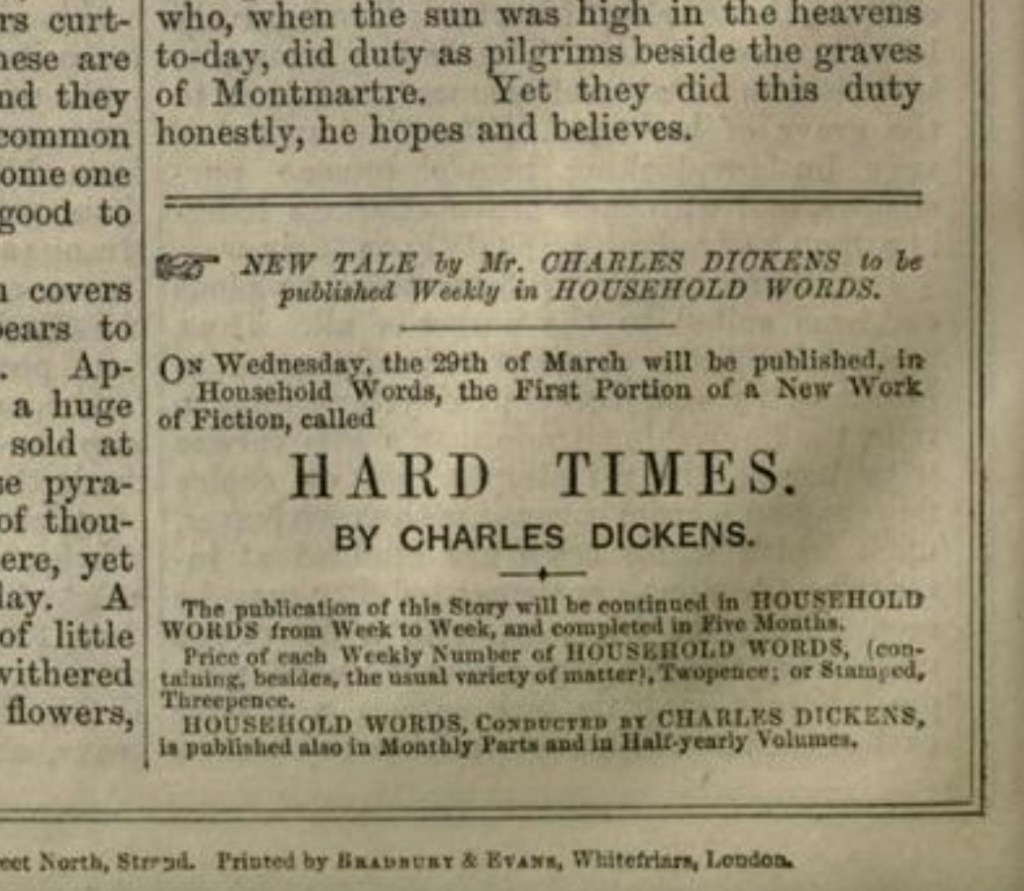
Today marks 170 years since Charles Dickens advertised what would become his latest novel to his public. That novel was Hard Times, one that he would serialise between April and August 1854 in his periodic journal Household Words. We are so used to reading Dickens’s novels as whole books that it is sometimes difficult to remember that they were published in instalments, usually between one to three chapters each week, often leaving his readers on a cliff edge of anticipation, with a sharply crafted hook at the end of each instalment to ensure his readers would be back for more. It was a formula that had proved enormously successful for Dickens, helping him to become one of the most beloved and successful authors of his time.
But by 1854, Dickens was becoming somewhat jaded, and not just with writing cloyingly sentimental characters such as Oliver Twist, Little Nell, and the tragic Paul Dombey. By the time he was writing Hard Times he had been married near on eighteen years, and he was showing signs of being desperately unhappy in his marriage. His wife Catherine was to bear the brunt of Dickens’s growing hostility and his sense of tedium with the monotony of comfortable domesticity that his life with her represented. But that is a story for another time.
As he was writing Hard Times, Dickens’s personal correspondence demonstrates his desire to break free from the constraints of married life, particularly evident in his developing friendship with the younger and unmarried Wilkie Collins, a ‘sensation’ novelist who would go on to write The Woman in White. Writing to Collins in July of 1854, as he neared the completion of Hard Times, Dickens, acting as though he was like Quilp from The Old Curiosity Shop, was determined to be, ‘a devil-may-care bachelor’, and invited Collins to meet up with him for an evening of ‘amiable dissipation and unbounded licence in the metropolis,’ Dickens referring to Collins’s enthusiasm for his vices, and in particular, womanizing. Dickens wanted more than a ‘jolt through a Slough of Despond, and… a long, long avenue of wrack and ruin,’ as he referred to marriage in Little Dorrit. He was feeling frustrated and trapped.
His sentiments were reflected in his writing. In Hard Times he engages with the indissolubility of marriage, as divorce as we know it today was not accessible at that time other than to a tiny, monied, minority. Yet his concern with divorce in his novel was somewhat narrow. Dickens shows no interest in freeing a wife from the bonds of marriage, even though it features a young woman, Louisa, married to a much older husband that she does not like, let alone love. There is no suggestion that the female middle-class Louisa should have access to divorce. It is only with the working-class Stephen Blackpool that Dickens can attack the inaccessibility of divorce for men, using Stephen’s ‘innocent and miserably wronged’ experience to examine the state of the law that makes it impossible for him to find relief from his miserable marriage. In writing Stephen’s story, Dickens depicted him as trapped in a relationship with a disgusting specimen of wifehood, inviting the reader both to be repulsed by her and to pity the man she is married to. Dickens is anything but kind to the wife of Stephen Blackpool. She is not even given a name in Dickens’s novel, seen as little more than an alcoholic scourge on the life of her miserable and pitiable husband.
Dickens is often criticised for the portrayal of women within his novels, so it is somewhat unsurprising that I think Dickens’s portrayal of Stephen’s wife is lacking. In reading Hard Times, I wished we had been given her side of the story, something that contextualises why she became the alcoholic wretch that she is in Dickens’s novel. But the reader is given nothing, other than Stephen’s vague and unconvincing protestations that the marriage started off well enough. I am not the first person to have been enraged by Dickens’s myopic vision of a failed marriage. George Eliot had a subtle dig at Dickens’s telling of the story in her first novel Scenes of Clerical Life (1857) where a wife, also prone to enjoying a drink or two, exclaims ‘indeed, indeed my lot has been a very hard one.’
I wanted Stephen’s wife to be more than a failed wife. I wanted to know her story. I decided to write it.
There is nothing new in taking Dickens’s work and adapting it for a new audience. It has been done since the first publications of Dickens’s writing, with Oliver Twist, for example, adapted for the stage in the same year as it was published. We have seen recent incarnations of Dickens’s stories with the 2023 BBC adaptation of Great Expectations (the less I say about that the better), and with Barbara Kingsolver’s Pulitzer and Women’s Prize-winning novel Demon Copperhead, an adaptation of Dickens’s David Copperfield, where Kingsolver appropriates the entire Dickensian narrative and transposes it into Appalachia America during the heart of the opioid crisis.
In my re-working of Hard Times, the much-maligned wife of Stephen Blackpool gets her own story and reclaims her agency and power as a woman in a world in which the working class were expendable and a wife was all but invisible. But I wanted to do more than just write a story. I wanted to set myself the challenge to write my Hard Times story as Dickens wrote his – in instalments. It has proven somewhat more difficult than what I anticipated and has given me a whole new perspective on the level of Dickens’s skill and genius, particularly given that Dickens was constrained by the space he had available in his journal each week, while I can write each instalment to whatever length I please, such are the joys of being able to publish online. I had hoped to have an entire draft ready to begin serialising on my website from 1 April, and while I have many words down on the page, I have not finished the draft. In fact, while I have written later parts of the story, having plotted the entirety of it in my head, I am only content with the first six instalments. The rest need work.
So, what to do? Publish weekly with what I have, or wait until the draft is complete?
In honour of the 170-year anniversary of the publication of Hard Times, I am going to publish, on a weekly basis, those first six instalments, hoping that I can get the rest of the story in shape as the weeks progress. I will have to see how that goes, as I have a PhD thesis to finish, work to go to, and unlike Dickens, I have neither his energetic genius, a wife nor a Georgina Hogarth to help with the running of my house.
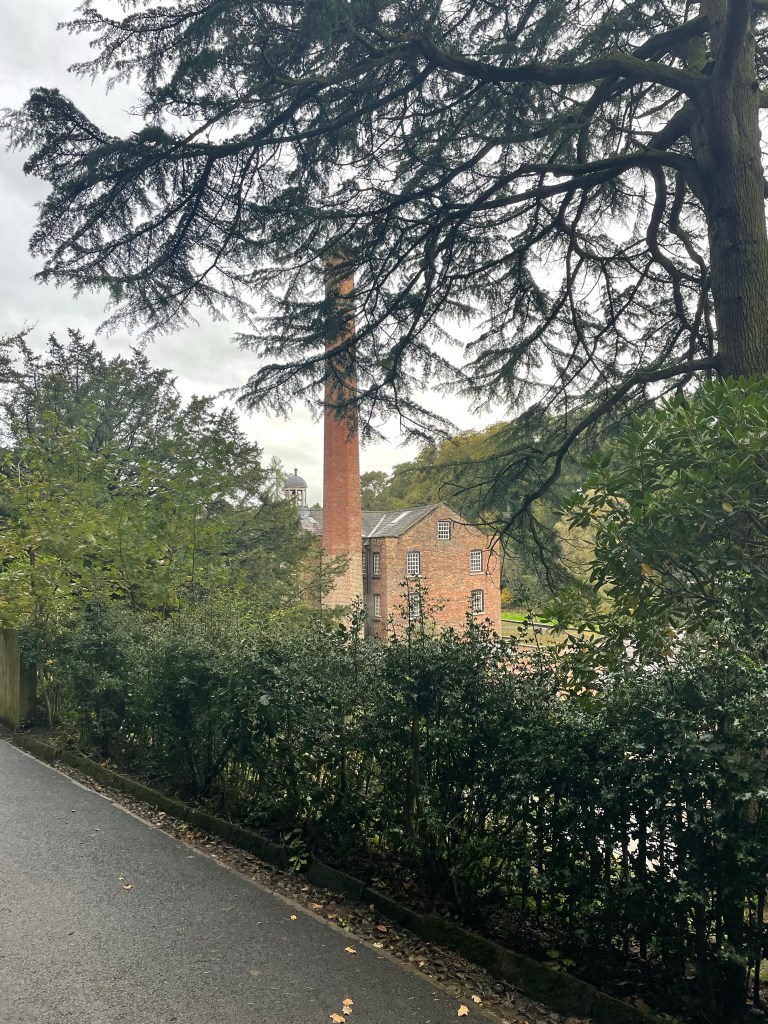
I have carried this story with me as I have written it, visiting working mills, reading as much as I can about life in the industrial North, as well as pouring over Dicken’s works as I write. It is Dickens’s story, but not his story, both at the same time. The first instalment will go online on 1 April, just as his went to print 170 years ago. I do hope you find something in it to enjoy.
 Deborah Siddoway